
Chest strap vs wrist heart rate: what do the studies say?
During your intervals, your watch shows a heart rate that lags or jumps around, while your breathing tells a different story. Chest strap or wrist: which one should you trust? Validation studies give a nuanced answer that depends on how hard you're working.
The KILYO team
The sports coach that reads your workouts
The short answer
When it comes to chest strap vs wrist heart rate, a 2019 treadmill study (Cardiovascular Diagnosis and Therapy) gave the Polar H7 chest strap an agreement of 0.98 with the ECG (1 = identical), versus 0.89 to 0.96 for the watches tested. At 12.9 km/h (8 mph) and above, no watch went above 0.70. Use a chest strap for intervals, fast paces, or heart rate zones. Your wrist is enough for steady effort.
Key takeaways
- On a treadmill, the Polar H7 chest strap had an agreement of 0.98 with the ECG, versus 0.89 to 0.96 for the watches tested.
- At rest and at steady effort, the wrist sensor stays close to the chest strap. It drifts at fast paces on a treadmill and when effort changes quickly.
- For intervals, fast paces, or training by heart rate zones, the chest strap is the safest choice.
Say you're doing 10 × 400 m (10 × 0.25 mi) intervals. On your watch, heart rate takes a while to climb, then drops too fast during recovery. On an easy run, the same sensor looks spot on. That's no accident.
Plenty of French buying guides at the top of Google claim the chest strap is more accurate, without citing a single study. The studies do exist, and they say something more useful: the gap depends on effort. Here's what they show on the treadmill, and the simple rule you can take from them based on the type of workout you're doing.
Two ways to read your heart
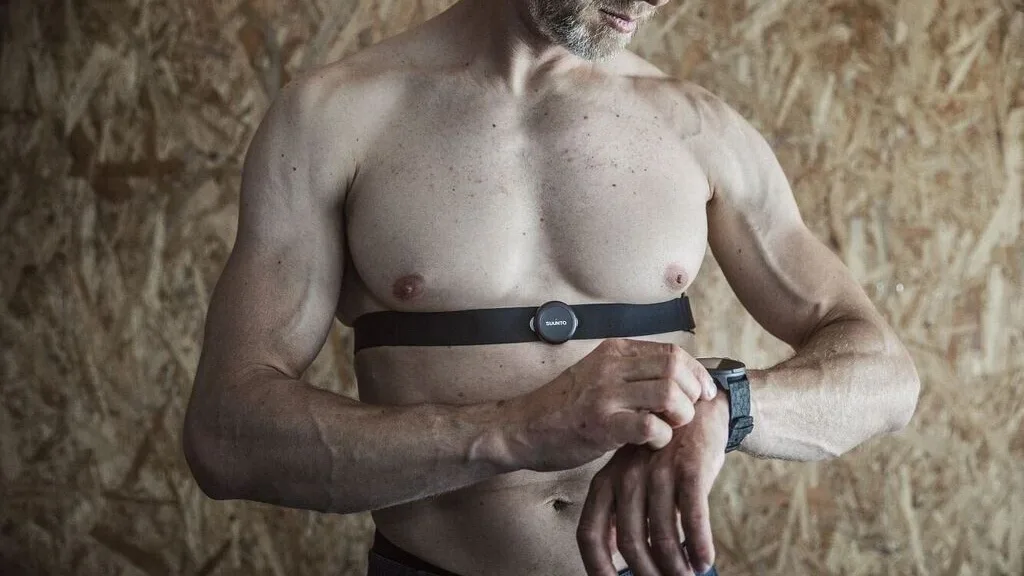
A chest strap places electrodes against your chest. It reads the heart's electrical activity, like an electrocardiogram (ECG). Each beat is detected at the source.
A wrist sensor shines light onto your skin and measures the light that bounces back. Blood flow changes that light, and the watch works out your heartbeats from it. It's an indirect measurement, so it's more sensitive to movement.
What the studies say: rest, steady effort, hard effort
A 2019 study published in Cardiovascular Diagnosis and Therapy had athletes run on a treadmill at six speeds, from 4 to 9 mph (about 6.4 to 14.5 km/h). Each device was compared with an ECG.
| Device | Agreement with ECG (CCC) |
|---|---|
| Polar H7 chest strap | 0.98 |
| Apple Watch III | 0.96 |
| Fitbit Iconic, Garmin Vivosmart HR, TomTom Spark 3 | 0.89 |
The chest strap comes out on top. A 2022 study (Sensors) compared the Polar H10 with an ECG during progressive exercise: 130.1 beats per minute (bpm) on average for the chest strap, 130.2 for the ECG.
That doesn't put the wrist out of the game. At rest, every device in the 2019 study measured correctly. In healthy people, a 2018 study (BMC Sports Science, Medicine and Rehabilitation) found an average error of at most 3 bpm and an agreement of 0.98 for an optical wrist sensor across many activities. A 2020 review (npj Digital Medicine) concludes that optical sensors are reasonably accurate at rest and during prolonged high-intensity effort.
When the wrist loses track
The same research points to three situations where the wrist drifts from the truth.
- Fast paces on a treadmill. In the 2019 study, watch accuracy dropped as pace went up. At 8 and 9 mph (about 12.9 and 14.5 km/h), no watch reached an agreement of 0.70.
- Effort changes quickly. The 2020 review notes that devices differ mostly in how they respond to changes in activity. That's exactly what happens in intervals: you go from recovery to effort in a few seconds.
- Your wrist moves in all directions. In the 2018 study, the largest errors came from activities with lots of irregular wrist movement, like housework or the gym.
The studies give those three situations. What follows is coaching inference, not a study result. An easy run or a long run at steady effort: the wrist holds up well there, and it stays reasonable during prolonged hard effort. 10 × 400 m repeats pile up rapid changes in activity and fast paces. That's where the gap is most likely to grow.
Skin tone: what science knows
Does skin tone change how accurate an optical sensor is? A systematic review of 10 studies (469 participants), published in 2023, calls the evidence preliminary and inconclusive. Four studies find no effect of skin tone, two have mixed results, and some suggest lower accuracy on darker skin.
A 2025 study (PLOS ONE) compares a Fitbit Charge 5 with a Polar H10 chest strap on a stationary bike. In participants with darker skin, the wrist error grew with intensity, reaching 11.7 bpm above 60% of heart rate reserve. It covers only one device and a small sample.
If you have darker skin, check your watch against a chest strap during hard workouts before you rely on it.
Choosing based on your effort and goal
The studies measure accuracy on a treadmill, on a stationary bike (for skin tone), and during everyday activities. None covers road cycling. The cycling rows in the table extend the effort logic, and no study backs them up.
| Your workout | Safest choice |
|---|---|
| Easy run, steady-effort long run | Wrist |
| Intervals, pace that changes fast | Chest strap |
| Fast paces (12.9 km/h or 8 mph and above on a treadmill) | Chest strap |
| Workout guided by heart rate zones | Chest strap |
| Cycling at steady effort (extrapolated) | Wrist |
| Interval cycling (extrapolated) | Chest strap |
| Swimming | No rule |
For swimming, no study cited covers water, so there's no rule to give you here.
If your workout depends on zones (for example, "20 minutes between 80 and 85% of your max heart rate"), a gap of a few beats changes the zone you think you're in. That's where a chest strap pays off. To calculate your zones:
What you can do at your next workout
- Pick a steady 30-minute workout and wear your chest strap and watch together.
- Repeat the test on an interval session, then compare both lines and the averages.
- If the gap is only a few beats, your watch is enough for this type of workout. If it's clear, use the chest strap for zone-based or interval workouts.
KILYO reads your watch workouts and adjusts your plan from that data: the more reliable the measurement, the more accurate the adjustment.
To build your week around these workouts, also check out how to improve your running with 3 workouts a week.
Frequently asked questions
Is my watch reliable for an easy long run?
Do housework or gym sessions throw off the reading?
Which number should I trust for my max heart rate?
Is a chest strap useful if I train without zones?
Sources
- Pasadyn S. R., Soudan M., Gillinov M. et al. (2019). Accuracy of commercially available heart rate monitors in athletes: a prospective study. Cardiovascular Diagnosis and Therapy. DOI
- Wrist-worn optical and chest strap heart rate comparison in a heterogeneous sample of healthy individuals and in coronary artery disease patients (2018). BMC Sports Science, Medicine and Rehabilitation. DOI
- Bent B., Goldstein B. A., Kibbe W. A., Dunn J. P. (2020). Investigating sources of inaccuracy in wearable optical heart rate sensors. npj Digital Medicine. DOI
- Validity of the Polar H10 Sensor for Heart Rate Variability Analysis during Resting State and Incremental Exercise in Recreational Men and Women (2022). Sensors. Article
- Koerber D. et al. (2023). Accuracy of Heart Rate Measurement with Wrist-Worn Wearable Devices in Various Skin Tones: a Systematic Review. Journal of Racial and Ethnic Health Disparities. DOI
- Hung et al. (2025). Validity of heart rate measurements in wrist-based monitors across skin tones during exercise. PLOS ONE. DOI
Written with the help of AI.